Tuesday, 13 July 2010

Away


The holiest of all holidays are those
Kept by ourselves in silence and apart;
The secret anniversaries of the heart,*

Even ideas to stay alive need fresh air. They have taken a holiday.
How can they be denied?

*Holidays by Henry Wadsworth Longfellow

Wednesday, 7 July 2010

Fossil fools

Men at forty
Learn to close softly
The doors to rooms they will not be
Coming back to.

We all know them. The unfortunate among us meet them everyday. In offices, on the roads, in the queue standing before us. Even misanthropes who are social media addicts meet them online. There is no escaping them. Like cockroaches hiding in old, decayed woodwork we know they are there even when we can’t see them. The fossil fools. In the corporate world they are known as ‘middle management’. And everywhere else as those middle-aged men.

They have achieved a level of mediocrity– comforting and self-sustaining. Even though they may not rise any higher up in life, they know, as they occupy the ‘middle’, that those on their way up will have to go past them. And the rest will soon join them. So they are comforted. Somehow this makes them more than a little proud of themselves.

Due to the above-mentioned advantage they build an entourage consisting of other “middle men” and juniors who in a few years time will morph into them. The accolade from juniors flatters them. The support of others like them empowers them.

But their life is not without its unique pitfalls. For how long can these fossil fools last? The wheels of progress won’t grind to a halt just because they have achieved the pinnacle of their mediocrity. There will always be smarter, bolder and more efficient ideas waiting to take over. What do they do then?

Thus begins the vicious battle unimaginatively called ‘defend the turf”. The motto being– he who blows his trumpet the loudest wins, never mind if he is out of tune and giving everyone a headache. Ruthless missions are launched to shore up large ‘followings’. Every bit of mediocrity is not only applauded but also richly awarded. Every little spark that threatens to burn down the entrenchments is mercilessly rubbed out. All middle men combine forces and they are out to take prisoners. Those unwilling to tow the line are ignored. For what one isn’t aware of, doesn’t exist. If one can’t see it, surely nobody else can. So says the cat among the pigeons as it closes its eyes.

Watching these desperate attempts to perpetuate mediocrity, we should raise our fists in anger and howl. Instead we gently shake our heads and whisper,

Men at forty
Learn to close softly
The doors to rooms they will not be
Coming back to.

At rest on a stair landing,
They feel it moving
Beneath them now like the deck of a ship,
Though the swell is gentle.

And deep in mirrors
They rediscover
The face of the boy as he practices tying
His father’s tie there in secret,

And the face of that father,
Still warm with the mystery of lather.
They are more fathers than sons themselves now.
Something is filling them, something

That is like the twilight sound
Of the crickets, immense,
Filling the woods at the foot of the slope
Behind their mortgaged houses.

–Men at forty by Donald Justice

Tuesday, 6 July 2010

New Learnings

When misanthropes become social media addicts, and no one notices the irony, you know it’s the worst of the times. And the best of the times. A time when every day brings new “learnings”.

Here’s what I learnt in the past one week.

1. Missing classes meant copying notes and catching up with what had been taught during our absence. Lessons weren’t repeated for our benefit. If we had doubts we could discuss them after class. Unsurprisingly, the world too operates on this principle. You missed what’s going on; it’s your prerogative to catch up.

Even to become a contrarian you need to understand conventions first.

However, if you are under 40 and don’t know what ‘tactical media’ is, despite being active on facebook and twitter. Despite doing PhDs from Oxford or Harvard. Despite working for a media outlet. In that case, it is simply time to re-evaluate your ‘education’.

2. People tweeting from their blackberries shouldn’t accuse those tweeting from their iPhones of being Luddites. Please get a dictionary. Or open a new tab and type ‘meaning Luddite’. Same rule applies for comments on facebook.

3. If someone claims to be an atheist and a meat eater chances are very high that they are most obsessed with religion and vegetarianism. That’s the curse of assuming ideas based on negation. The anti-ideology.

4. No matter what meat eaters, who may or may not be atheists, choose to believe - yes, being an atheist also requires following a system of beliefs, there’s a reason why most men and women capable of reasoning are calling for people to consume less or no meat at all.

If you don’t understand the problem with factory farming, over fishing, or how eating a solely meat based diet is resulting in wastage of resources and is unsustainable, don’t make facile arguments about plants being helpless (plants aren’t helpless they have been on this planet since before humans evolved).

That is unless you haven’t ever laid eyes upon any biology text. In that case read more.

5. Everybody has to live with his or her own peculiar contradictions. No matter how ridiculous.
Richard Dawkins on Vegetarianism: “What I am doing is going along with the fact that I live in a society where meat eating is accepted as the norm, and it requires a level of social courage which I haven’t yet produced to break out of that. It’s a little bit like the position which many people would have held a couple of hundred years ago over slavery. Where lots of people felt morally uneasy about slavery but went along with it because the whole economy of the South depended upon slavery.“

6. Everything is connected. Often there is less than six degrees of separation. E.g. your desire for sushi for dinner once a week - extinction of blue fin tuna.

7. In the US, according to Cornell Lab of Ornithology, people think house sparrows grow up to become pigeons. This gives a clear idea of how much thought people put in before arriving at a conclusion. We see how deep the abyss is. We realize how much patience is needed to fill the gap with.

Postscript: Yesterday I realized bandhs are good for the country. Smashing public and private property, coercing people to stay at home through threat of violence, putting the country under an emergency like situation is the only way to get “people like us” to talk to the "poor" (okay just the taxi driver) and realize that inflation and price rise are badly affecting them. Shouldn’t we be calling for more bandhs?

Thursday, 1 July 2010

Postcards from islands by the sea


Here is where the sky is blue! We reflect. Reality maybe deceptive.
But the truth is always true.

Home is a metaphor. A four letter word. A synonym for hope. A handful of twigs.

Everyone is equal beneath the clouds, besides the sea. The breeze that
caresses her, brushes the cheeks of he.

No one ever walks alone. There are the shadows. There is the sea. The sea.

(Mumbai, or Bombay as it was formerly known, is made up of seven islands. In 1782 the Hornby Vellard project was started to build a causeway to unite all seven islands into a single island with a deep harbour. With its completion in 1854, along with laying down of roads and the railway, Bombay became a major sea port in the Arabian Sea.)

Sunday, 27 June 2010

Cambodia

As the dark clouds gather, threatening thunder and rain, we talk about Cambodia. Not that there was rain when we were in Cambodia, far from it. But rainy afternoons when all one can do is watch the water colour the landscape makes the mind meander and Cambodia may just as well be where it may choose to roam.

We say yes, let’s talk about Cambodia. But let’s not talk about the shoot. At least not the producer. And absolutely not about the National Geographic photographer. And we agree not to. But let’s talk about the shoot. You know the shoe shine boy and the ladies with their babies. Oh! Yes, yes, we remember. But let’s not talk about ‘channeling Steve McCurry’: the little lama with the index finger close to his lips, the girl with the blazing eyes and pink headscarf. And we laugh. For we remember the book and the “inspiration” for the photographs. But then we also remember the airport where we saw the book. So, she says, let’s not talk about the airport. The military men with steel in their eyes. We say almost in unison, this is no afternoon to talk about military men and airports! And there is silence. We remember but choose not to talk about the military, or the history and even those other photographs- black and white and chilling. For what can one add to all that has already been said?

Then he says remember the sunrise over Angkor Wat. Again there is silence. By now the rain like silver sheets is busy obliterating the beautiful watercolour that it had painted just a few minutes back. Cold, dark lines of grey on grey. We remember Siam Reap and the trees that are taking their time to shred apart, stone by stone, what was once the pride of the Khmer rule, unlike humans they lack both pride and perhaps also a heightened sense of purpose.

We might as well talk about the Foreign Correspondence Club and that lunch, which we know, even though we may not want to, we always do end up talking about. She says, hope the crab tasted good because everything else, to be honest, was unpalatable, But the mention of sea food has already transported us to the Russian market in Phnom Penh; the humidity and the overpowering smells. Unmindful of the rain she opens the windows. But we are already talking about Phnom Penh and of course, the Russian market.

However, we know that the discussion has been salvaged. For we shall talk about Mekong and Tonle Sap- the beautiful water bodies. The boat cruises, the Japanese tourists, the monks and the sunset, the butterflies and the children. Once we get to the children, Cambodia will overwhelm our hearts. And soon we shall run out of words. The children of Cambodia leave such an enduring impression.

So we did talk. It hasn’t rained in two days. The sky is an astonishing shade of blue behind puffed up white clouds.

Sunday, 20 June 2010

The Cannonball Tree

The Dutch are pragmatic, the English are self-deprecating, the Americans are “awesome” and Indians, well, Indians are officious. The above characterization is based on random observations of people and has never (almost never) been empirically proven. Though in the case of Indians the observation has been long and hard. And considering how the population at large aspires for a government job, very nearly true.

There are other observations too. In India, when someone says they love gardening they don’t mean they bend down on their knees and slog away come rain or shine. Or for that matter revel in the joy of watching a seed sprout tiny tendrils that would go on to become something truly beautiful. There are other miracles they prefer like the ones that turn a gerbera into a sunflower when it’s in a vase on their dining table. Actually what they mean is that they love the fact that they can afford someone to come 3 times a week to take care of “their garden”.

Also in India when they call a housing complex green, they don’t mean “green” in the environmentally-friendly sense. No, they don’t even mean it in the sense of the building complex having a park. They only mean that something green in colour maybe a few bushes or a few trees can be found in the vicinity.

While we are on the word park, it often means a patch of grass, there maybe some neatly pruned bushes, but what’s more important is the paved jogging track. Who said anything about the park in a city being a bio-diverse landscape with different species of native trees and plants, and birds, not to forget the odd wild mammal? Do you think you are living in London? Anyway we have “enough” National Parks in the back of beyond to spend our vacation at. And malls to spend our weekends in.

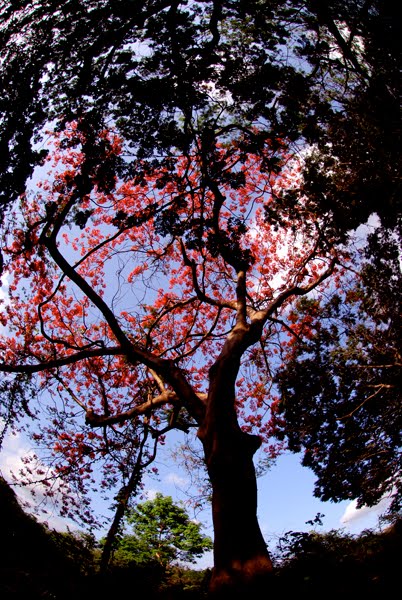
So, if you spot a cannonball tree that has attained its true majestic glory in the heart of Mumbai– don’t get excited. And don’t even think of taking photographs. There will always be some man who’ll come up and say, “Don’t take pictures. You are not allowed to take pictures” A tree can be easily ignored, and almost as easily chopped down. But the opportunity to extract a fine (should it be 50 or 100 rupees), especially where none exists, isn’t easily found. For what are rules– but made by humans like us? Did I tell you that Indians are officious?

Thursday, 17 June 2010

Some rain and a million thoughts


Rain by Shel Silverstein

I opened my eyes
And looked up at the rain,
And it dripped in my head
And flowed into my brain,
And all that I hear as I lie in my bed
Is the slishity-slosh of the rain in my head.

I step very softly,
I walk very slow,
I can't do a handstand--
I might overflow,
So pardon the wild crazy thing I just said--
I'm just not the same since there's rain in my head.


The Rainy Day by Henry Wadsworth Longfellow

The day is cold, and dark, and dreary
It rains, and the wind is never weary;
The vine still clings to the mouldering wall,
But at every gust the dead leaves fall,
And the day is dark and dreary.

My life is cold, and dark, and dreary;
It rains, and the wind is never weary;
My thoughts still cling to the mouldering Past,
But the hopes of youth fall thick in the blast,
And the days are dark and dreary.

Be still, sad heart! and cease repining;
Behind the clouds is the sun still shining;
Thy fate is the common fate of all,
Into each life some rain must fall,
Some days must be dark and dreary.


Oh, Gray And Tender Is The Rain by Lizette Woodworth Reese

Oh, gray and tender is the rain,
That drips, drips on the pane!
A hundred things come in the door,
The scent of herbs, the thought of yore.

I see the pool out in the grass,
A bit of broken glass;
The red flags running wet and straight,
Down to the little flapping gate.

Lombardy poplars tall and three,
Across the road I see;
There is no loveliness so plain
As a tall poplar in the rain.

But oh, the hundred things and more,
That come in at the door! --
The smack of mint, old joy, old pain,
Caught in the gray and tender rain.

Friday, 11 June 2010

Woman on the Edge of Time


Woman on the edge of time by Marge Piercy (1976)

Parallel universes: universes that are separated from each other by a single quantum event.

Parallel universes exist. This I know because in another world there was once a dinner party. The wood fire warmed the room. From the hooks at the fireplace hung two pots of spicy baingan bharta and palak ka saag. All part of our vegan feast prepared by S. Though he did laugh at the fact that he was cooking Indian food for us.

The giant ficus plant that concealed the bathtub from the rest of the room, every now and then, dropped a yellowed leaf. We sat around the wooden dining table, eating, drinking and talking. Roaming from the coast of Brittany to the mountain villages of Uttarakhand. Then M said, “Lets play a game. One by one we shall talk about a book we have recently read or are presently reading.” And we said how does the game go. And she said, “That’s it. We talk about the book we have read or are reading.” And everyone laughed. But what a game it was! What a treasure it revealed.

This could have been another one of those stories that I conjure out of nothing. However, I have that book in my hands. So it was real. But that dinner party appears to exist in a time and age far removed from present reality. So, did it really happen? Or, was it just a dream? Well it was simply an excursion into another world.

Woman on the Edge of Time also deals with such an excursion. Its main character Connie is poor, Hispanic, abused, labeled a sociopath and incarcerated in a mental asylum. But she is “receptive” to Luciente and the people of Mattapoisett living in 2137. People from a future world that would cease to exist if Connie isn’t able to change things in her present. Connie’s struggle to not get forced into a brain control operation mirrors the struggle that every human, with varying intensity, undertakes. The struggle against oppression. The struggle for beauty and truth. The struggle to exist. And that is what the story is about.

How one reads the story and what one takes away from this book depends largely on what one believes: on one’s ideological position. For this book challenges ideas regarding gender roles, racism, imperialism, consumerism, science and technology, and environment degradation. Is Connie insane or a victim of gender, ethnicity and economic disparity? How does one even define sanity? Can we truly have a society where everyone is equal no matter what gender, ethnicity or class? What would that mean for the one thing that sets women apart from men: childbearing? Is more science and more technology really our hope for salvation? At a more simplistically level, is all scientific research really guided by idealism? Is the agrarian, communal, gender neutral life of Mattapoisett the utopian just and equitable world we yearn for? Or is the totalitarian dystopia, the alternate that Mattapoisett is at war with, and Connie accidentally stumbles upon, our future reality?

“We can only know what we can truly imagine. Finally what we see comes from ourselves.” *

Postscript
It is often said that another world is possible. And it is often found that those who utter these words do so because they clearly see all the injustices that persist in our world. They see and feel them so clearly that in some other world they, immobilized by grief, horror and lack of faith in humans, would accept things without questioning. But instead they are often the most hopeful people. They think that change will come because they believe in the essential goodness of humans. And even if they fail, in the end they triumph simply because they tried. But above all they are truly happy. This I know because in another world I had dinner with them.

*Luciente to Connie in Woman on the Edge of Time.

(Afterthought on books: part 14)

Friday, 4 June 2010

Stories from the sea


Father And Child by William Butler Yeats

She hears me strike the board and say
That she is under ban
Of all good men and women,
Being mentioned with a man
That has the worst of all bad names;
And thereupon replies
That his hair is beautiful,
Cold as the March wind his eyes.


A Tale by Louise Bogan

This youth too long has heard the break
Of waters in a land of change.
He goes to see what suns can make
From soil more indurate and strange.

He cuts what holds his days together
And shuts him in, as lock on lock:
The arrowed vane announcing weather,
The tripping racket of a clock;

Seeking, I think, a light that waits
Still as a lamp upon a shelf, —
A land with hills like rocky gates
Where no sea leaps upon itself.

But he will find that nothing dares
To be enduring, save where, south
Of hidden deserts, torn fire glares
On beauty with a rusted mouth, —

Where something dreadful and another
Look quietly upon each other.


Behind, perhaps, let the sea blow… by Carlos Barbarito

Behind, perhaps, let the sea blow.
Let some word blow
outside every destination of slime, rust.
Perhaps ointments from Avicenna,
forests of embraces,
crops, swarms, humid implications.
Or, perhaps, the same.
It sits up. It gets dressed. It goes.
The grass stands up again.
At his step everything seems to find
inside itself a certain form of calm.
It can’t be a great distance
- he thought.

© translation: Brian Cole

Monday, 31 May 2010

Our lady of the birds


It happens quiet like this. You are walking in that typical gait; feet shuffling slowly, head tilted up, eyes peering through the leaves, looking for, but of course, birds. And then a voice whispers in your ears, “Do you want to see birds? Come I will show you, there are many birds here.”

And she leads you to the bushes where everyday in the morning the magpie robin waits to greet her. Or the small patch of wild grass where the white-breasted munias have a lunch date. Or the lone fig tree where, if you look long and hard enough, you can spot owls and hornbills. She is our lady of the birds.

She can be found often toiling hard at the most mundane of tasks. Cleaning toilets in the hotel, carrying firewood as she rushes home to cook dinner, picking discarded plastic bottles casually thrown from passing cars, or washing clothes by the tube well. Sometimes she even takes on the avatar of two boys on a bicycle, or of old men chewing sugarcane, or of the girl with red ribbons in her hair walking back home from school.

In fact, she maybe anyone anywhere doing the one thing that you are least likely to notice. Even she is least likely to notice you until you start looking for birds. Then she’ll magically appear and lead you by the hand to bird paradise.

For Usha and her birds. With gratitude.

Saturday, 29 May 2010

The Science of Sleep


The Science of Sleep (2006), Directed by Michel Gondry.

Either you get into a film since the first shot, or you slowly slip into the lives of the characters as it progresses, or sometimes no matter how hard you try the film completely eludes you. The science of cinema is much like the science of sleep. Not surprisingly people have such divergent experiences even when they have watched the same story unfold on the big screen. Though what is surprising is how everyone is such an involved and passionate critic when it comes to films but has so little to say about the events in ‘real’ life. However, I digress.

It is not yet time for bed. Tom Waits playing in the background sings,

When I'm lyin' in my bed at night
I don't wanna grow up
Nothin' ever seems to turn out right
I don't wanna grow up

And then after a few more songs he starts to say,

but you're innocent when you dream
when you dream
you're innocent when you dream

But again I digress.

As adolescents we’d stay up well through the night because life was short and sleeping was a waste of time. But then we also believed that we could grow up to become almost anyone we wanted. And the story of our adulthood would be dominated by only one character – the almighty me.

However, now as thirty somethings there is nothing we look forward to more than sleep time. In fact, we are often reluctant to wake up to face another day in the life. For in dreams lies our real world.

At last coming to the film in question – what is there not to love about this whimsical (you say, write genius) film about Stéphane meeting Stephanie and (we all) meeting his world of dreams? As the boundary between dreams and reality blurs, how does one distinguish between the two? They say in our dreams the ‘impossible becomes possible’. But who is to say what is impossible to begin with?

People may either dream about a plane not taking off or of a dead relative gifting them a ruby ring. Similarly there are many ways of ‘seeing’ this film. Best to let our imagination and creativity make sense of our dreams and reality.

I'm exhausted, I'm gonna wake up now.


(On cinema part 3)

Thursday, 27 May 2010

Days go by

Then there are those days when we talk. With a gentle shrug of the shoulders we throw away the all-encompassing, oxygen-squeezing shroud of silence and become ourselves again. We become sentient: thinking and feeling beings. There is no need to mumble our words or push deeper into the dark corner of our brains the ideas that are waiting to explode. There is no need for wild gestures even. Everything is said and now it just needs to be done.

And then there’s the rest of our life. We go through all the motions. But the dominant gesture is always ‘disregard’. Hearing, speaking, nodding - ignoring. Smiling, asking, thinking-ignoring. Doing, seeing, choosing - ignoring. We ignore lest we say something that the significant other would find hard to ignore. We ignore lest we do or feel something that would become impossible to disregard. Ignoring is our retreat. Our asylum of choice.

And so, after all the ignoring has been done, there is but one thing left to do. Pick up the shroud and hope that it is thick and dark enough to blot out the ideas shining within. Until that some day when we can freely talk.

Tuesday, 25 May 2010

Reading Nietzsche

“Why do you act as if you live in an ivory tower, far removed from the rest of us?” This was spoken in a tone designed to inflict maximum pain. As is the wont of 14 year old girls, especially in the presence of a captive audience. But you, safe in your ivory tower, just grinned noting that your pigtails were much shorter compared to hers. So the moment passed. The conversation moved on to Agatha Christie, P.G. Wodehouse and Jane Austen. As it did ever so often in those days. Till one fine day everyone lost touch.

Some twenty years later she is a doctor, married to another doctor, mother to two sons, living in a tower in New York but strangely has nothing much to say about anybody or anything.

You, well, you read Nietzsche. You never did have anything to say about anybody or anything.

Amusingly you too live in a tower – you call it “ my citadel*”.

*Every superior human being will instinctively aspire after a secret citadel where he is set free from the crowd, the many, the majority.
(Man alone with himself- Friedrich Nietzsche)

Sunday, 23 May 2010

The Crow


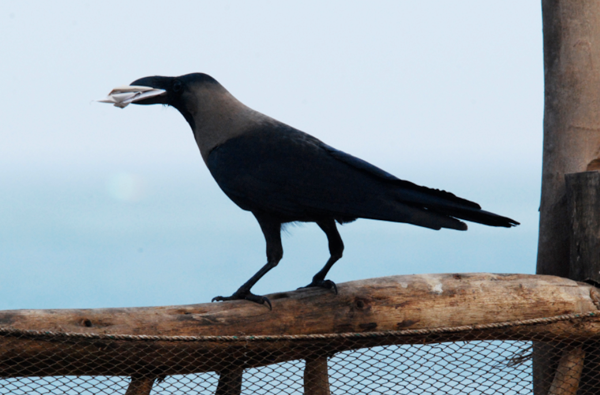
The crow offered me the first bite, generously. Politely I had to refuse. Our friendship was by now so congenial that I choose not to bring up the issue of my vegetarianism. I feared that something so trivial might soon snowball into an insurmountable mountain of mutual dislike. Like it happens often in human friendships. But I should have known better. For it was a crow that I had befriended. Giving me a deep, keen look the bird nodded his head and got back to his snack.

Did he know why I refused his friendly offering? I don’t quite know the answer to that. It never came up. However, there have been no wormy offerings of friendships ever since but many a cheery caw and circling over the head. And even a few striking poses among the blooming gulmohar. Yeah, we are alright. At least for now.

In fact, Mark Twain was onto something when he wrote that the crow “never arrived at what he is by any careless process, or any sudden one; he is a work of art, and "art is long"; he is the product of immemorial ages, and deep calculation; one can't make a bird like that in a day.”

(You can read Mark Twain's brilliant essay on the Crow here)

Friday, 21 May 2010

Was there a time


Was there a time when dancers with their fiddles
In children's circuses could stay their troubles?
There was a time they could cry over books,
But time has set its maggot on their track.
Under the arc of the sky they are unsafe.
What's never known is safest in this life.
Under the skysigns they who have no arms
Have cleanest hands, and, as the heartless ghost
Alone's unhurt, so the blind man sees best.

(Was There A Time by Dylan Thomas)

Wednesday, 19 May 2010

Does your conscience bother you

The glory of friendship is not the outstretched hand,

nor the kindly smile nor the joy of companionship;

it is the spiritual inspiration that comes to one when

he discovers that someone else believes in him and is

willing to trust him.

Glory of Friendship by Ralph Waldo Emerson


or, in other words


If a dog will not come to you after having looked in your face, you should go home and examine your conscience.

- Woodrow Wilson

Wednesday, 5 May 2010

Postcards from Italy

waiting to be addressed...


The times we had
Oh, when the wind would blow with rain and snow
Were not all bad
We put our feet just where they had, had to go
Never to go...


Those were our times, those were our times