Showing posts with label Life in India. Show all posts

Monday, 11 October 2010

The fading


Moments turn into minutes, days stumble one into the other, months
into years, and time, it is said, has passed. We say life has moved
on. Not realizing time and life are two independent entities. Mutually
exclusive. Rarely does one care for the other.

Rain falls on Bombay. This is Bombay with its ancient banyan trees and
chawls with pots of hibiscus flowering red and yellow on the
windowsills. And corrugated iron sheets hiding from public view the
gaping hole in the earth that will, in some days and months, turn into
a gleaming steel and glass monstrosity. Slowly, over days and months,
it will rise from the hidden depths. However, time will not wait. It
will lapse.

Shaded by umbrellas, small and inadequate, against the monsoon
downpour, there will be life, or something like it. And maybe at some
moment, on some given day, it’ll summon the courage to softly ask,
"But what is the meaning of it all?” Time will most likely not reply.
Life will try to catch its fading reflection rippling in a pool of
rainwater. Or maybe it will simply sigh. And pass on.

Thursday, 19 August 2010

Thursday

It is already Thursday! There is much to be done. Things to do– lists, yes there are multiples of them in a futile attempt to arrive at the best possible way to do everything in the least possible time. Prioritise. How can one do that? Wont it mean placing greater value on
one thing over the others? But they are all things that need doing, and each on completion will lead to a certain sense of fulfillment and other things to do. The choice isn’t simply between vanilla and strawberry. Though you may argue even that isn’t so simple sometimes.

Then there is the rain. It has been raining continuously for two days. How can one do anything but watch it rain? A river flows beneath the parked cars. Wouldn’t one like to find out where it goes? Shouldn’t that be on one of the lists? The sparrows are settling down in the balcony. There is much to “chee chee” about before they are all comfortable; organized according to their pecking order. Then silent and still they will watch the worst of the rain pass by. Time to pick
up the camera. But for the light.

And then while sorting through all these sensory impulses one looks back at the screen and there is Patti Smith reading from The Waves by Virginia Woolf. After replaying it three times one goes on to hear Dancing Barefoot because that’s how the mind works. Then the book Street Haunting is picked up and after reading a few lines from the first essay one starts to recollect the gulls swirling around the dome of St Peter’s at 10:30 at night. Such poetry. And one instantly whispers, “Send a philosopher to London; please God no poet!”*

A truck carrying construction waste blows its horn. Somewhere a house of cards collapses. Is this the butterfly effect?

Coming back to the desk and everything else it encapsulates one catches sight of the work to be done. And the lists. Multiples of them. Ah! But it is only Thursday.

*Heinrich Heine. More about this soon.
You can watch Patti Smith's performance here.
Or read Street Haunting– the complete essay here. Go on try it. It's only Thursday.

Sunday, 15 August 2010

Take birth on Facebook and die in the pages of mainstream media: The short and irrelevant life of protest movements in urban India

Let me start by saying: I have nothing against “we the people” ensuring that errant citizens are brought to book or forced to comply with the laws of the land. That is worth commending. But I’d just like to add a caveat: Those who live in glass houses shouldn’t throw stones at others.

Meaning, dear fellow citizens first learn to wear the helmet, drive in lanes, not jump traffic lights, not unnecessary blow the horn, not over speed– you know follow basic traffic rules, (that you are required to be aware of to get a driving license) before trying to force autos and taxis out of the roads. That the recent attempt to keep taxis and autos off the road in Mumbai failed miserably, no matter how people like us choose to spin it, is an entirely different matter.

Which brings me to the more important point. Autos and taxis aren’t the "villains” and autowallahs aren’t “chors”. The fact that the problem was framed in these terms is the reason why the solution offered was inappropriate, if not downright silly. In another India, educated (and might I add civil) citizens would first attempt to understand what does public transport mean? Then go on to wonder why don’t we have good public transport and instead have so many autos and taxis on the roads in our cities? Then find out who are these people who drive these autos and taxis, where do they come from, and why do they leave from wherever they have left?

When we have asked and sought answers to these questions we would (I hope) not come up with "protests" that only widen the gap between “us” and “them”. Instead we would concentrate our energies in ensuring that the real errant citizens obey the laws of the land and the real “chors” are bought to book. Okay, maybe simply start a social media campaign and get enough “likes” to make it to the pages of the mainstream media. But at least then it wouldn’t all have been so vain.

Meanwhile an educated and enlightened take on auto-rickshaws and the life of those who drive them can be found here.

Wednesday, 7 July 2010

Fossil fools

Men at forty
Learn to close softly
The doors to rooms they will not be
Coming back to.

We all know them. The unfortunate among us meet them everyday. In offices, on the roads, in the queue standing before us. Even misanthropes who are social media addicts meet them online. There is no escaping them. Like cockroaches hiding in old, decayed woodwork we know they are there even when we can’t see them. The fossil fools. In the corporate world they are known as ‘middle management’. And everywhere else as those middle-aged men.

They have achieved a level of mediocrity– comforting and self-sustaining. Even though they may not rise any higher up in life, they know, as they occupy the ‘middle’, that those on their way up will have to go past them. And the rest will soon join them. So they are comforted. Somehow this makes them more than a little proud of themselves.

Due to the above-mentioned advantage they build an entourage consisting of other “middle men” and juniors who in a few years time will morph into them. The accolade from juniors flatters them. The support of others like them empowers them.

But their life is not without its unique pitfalls. For how long can these fossil fools last? The wheels of progress won’t grind to a halt just because they have achieved the pinnacle of their mediocrity. There will always be smarter, bolder and more efficient ideas waiting to take over. What do they do then?

Thus begins the vicious battle unimaginatively called ‘defend the turf”. The motto being– he who blows his trumpet the loudest wins, never mind if he is out of tune and giving everyone a headache. Ruthless missions are launched to shore up large ‘followings’. Every bit of mediocrity is not only applauded but also richly awarded. Every little spark that threatens to burn down the entrenchments is mercilessly rubbed out. All middle men combine forces and they are out to take prisoners. Those unwilling to tow the line are ignored. For what one isn’t aware of, doesn’t exist. If one can’t see it, surely nobody else can. So says the cat among the pigeons as it closes its eyes.

Watching these desperate attempts to perpetuate mediocrity, we should raise our fists in anger and howl. Instead we gently shake our heads and whisper,

Men at forty
Learn to close softly
The doors to rooms they will not be
Coming back to.

At rest on a stair landing,
They feel it moving
Beneath them now like the deck of a ship,
Though the swell is gentle.

And deep in mirrors
They rediscover
The face of the boy as he practices tying
His father’s tie there in secret,

And the face of that father,
Still warm with the mystery of lather.
They are more fathers than sons themselves now.
Something is filling them, something

That is like the twilight sound
Of the crickets, immense,
Filling the woods at the foot of the slope
Behind their mortgaged houses.

–Men at forty by Donald Justice

Sunday, 20 June 2010

The Cannonball Tree

The Dutch are pragmatic, the English are self-deprecating, the Americans are “awesome” and Indians, well, Indians are officious. The above characterization is based on random observations of people and has never (almost never) been empirically proven. Though in the case of Indians the observation has been long and hard. And considering how the population at large aspires for a government job, very nearly true.

There are other observations too. In India, when someone says they love gardening they don’t mean they bend down on their knees and slog away come rain or shine. Or for that matter revel in the joy of watching a seed sprout tiny tendrils that would go on to become something truly beautiful. There are other miracles they prefer like the ones that turn a gerbera into a sunflower when it’s in a vase on their dining table. Actually what they mean is that they love the fact that they can afford someone to come 3 times a week to take care of “their garden”.

Also in India when they call a housing complex green, they don’t mean “green” in the environmentally-friendly sense. No, they don’t even mean it in the sense of the building complex having a park. They only mean that something green in colour maybe a few bushes or a few trees can be found in the vicinity.

While we are on the word park, it often means a patch of grass, there maybe some neatly pruned bushes, but what’s more important is the paved jogging track. Who said anything about the park in a city being a bio-diverse landscape with different species of native trees and plants, and birds, not to forget the odd wild mammal? Do you think you are living in London? Anyway we have “enough” National Parks in the back of beyond to spend our vacation at. And malls to spend our weekends in.

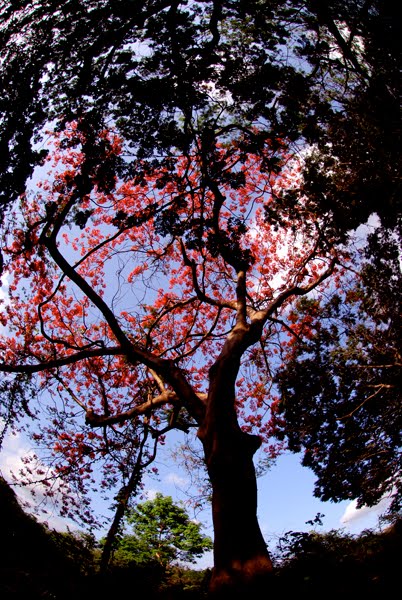
So, if you spot a cannonball tree that has attained its true majestic glory in the heart of Mumbai– don’t get excited. And don’t even think of taking photographs. There will always be some man who’ll come up and say, “Don’t take pictures. You are not allowed to take pictures” A tree can be easily ignored, and almost as easily chopped down. But the opportunity to extract a fine (should it be 50 or 100 rupees), especially where none exists, isn’t easily found. For what are rules– but made by humans like us? Did I tell you that Indians are officious?

Thursday, 17 June 2010

Some rain and a million thoughts


Rain by Shel Silverstein

I opened my eyes
And looked up at the rain,
And it dripped in my head
And flowed into my brain,
And all that I hear as I lie in my bed
Is the slishity-slosh of the rain in my head.

I step very softly,
I walk very slow,
I can't do a handstand--
I might overflow,
So pardon the wild crazy thing I just said--
I'm just not the same since there's rain in my head.


The Rainy Day by Henry Wadsworth Longfellow

The day is cold, and dark, and dreary
It rains, and the wind is never weary;
The vine still clings to the mouldering wall,
But at every gust the dead leaves fall,
And the day is dark and dreary.

My life is cold, and dark, and dreary;
It rains, and the wind is never weary;
My thoughts still cling to the mouldering Past,
But the hopes of youth fall thick in the blast,
And the days are dark and dreary.

Be still, sad heart! and cease repining;
Behind the clouds is the sun still shining;
Thy fate is the common fate of all,
Into each life some rain must fall,
Some days must be dark and dreary.


Oh, Gray And Tender Is The Rain by Lizette Woodworth Reese

Oh, gray and tender is the rain,
That drips, drips on the pane!
A hundred things come in the door,
The scent of herbs, the thought of yore.

I see the pool out in the grass,
A bit of broken glass;
The red flags running wet and straight,
Down to the little flapping gate.

Lombardy poplars tall and three,
Across the road I see;
There is no loveliness so plain
As a tall poplar in the rain.

But oh, the hundred things and more,
That come in at the door! --
The smack of mint, old joy, old pain,
Caught in the gray and tender rain.

Friday, 4 June 2010

Stories from the sea


Father And Child by William Butler Yeats

She hears me strike the board and say
That she is under ban
Of all good men and women,
Being mentioned with a man
That has the worst of all bad names;
And thereupon replies
That his hair is beautiful,
Cold as the March wind his eyes.


A Tale by Louise Bogan

This youth too long has heard the break
Of waters in a land of change.
He goes to see what suns can make
From soil more indurate and strange.

He cuts what holds his days together
And shuts him in, as lock on lock:
The arrowed vane announcing weather,
The tripping racket of a clock;

Seeking, I think, a light that waits
Still as a lamp upon a shelf, —
A land with hills like rocky gates
Where no sea leaps upon itself.

But he will find that nothing dares
To be enduring, save where, south
Of hidden deserts, torn fire glares
On beauty with a rusted mouth, —

Where something dreadful and another
Look quietly upon each other.


Behind, perhaps, let the sea blow… by Carlos Barbarito

Behind, perhaps, let the sea blow.
Let some word blow
outside every destination of slime, rust.
Perhaps ointments from Avicenna,
forests of embraces,
crops, swarms, humid implications.
Or, perhaps, the same.
It sits up. It gets dressed. It goes.
The grass stands up again.
At his step everything seems to find
inside itself a certain form of calm.
It can’t be a great distance
- he thought.

© translation: Brian Cole

Monday, 31 May 2010

Our lady of the birds


It happens quiet like this. You are walking in that typical gait; feet shuffling slowly, head tilted up, eyes peering through the leaves, looking for, but of course, birds. And then a voice whispers in your ears, “Do you want to see birds? Come I will show you, there are many birds here.”

And she leads you to the bushes where everyday in the morning the magpie robin waits to greet her. Or the small patch of wild grass where the white-breasted munias have a lunch date. Or the lone fig tree where, if you look long and hard enough, you can spot owls and hornbills. She is our lady of the birds.

She can be found often toiling hard at the most mundane of tasks. Cleaning toilets in the hotel, carrying firewood as she rushes home to cook dinner, picking discarded plastic bottles casually thrown from passing cars, or washing clothes by the tube well. Sometimes she even takes on the avatar of two boys on a bicycle, or of old men chewing sugarcane, or of the girl with red ribbons in her hair walking back home from school.

In fact, she maybe anyone anywhere doing the one thing that you are least likely to notice. Even she is least likely to notice you until you start looking for birds. Then she’ll magically appear and lead you by the hand to bird paradise.

For Usha and her birds. With gratitude.

Saturday, 1 May 2010

The bar. Code.

“Debates, I tell you,” you start. It’s one of those days. Only instead of late nights, it’s in the middle of the day that we’ve gather around to listen. And what better way to pass the time. I say it sans all sarcasm. Or maybe not.

The AC works hard to keep the room at a ‘pleasant’ 20 degree Celsius. The first person to mention climate change or carbon footprint is quickly banished to the common lot outside. A few minutes in the ‘real’ world, with the added heat reflected from the million odd cars parked there, and anyone can be tempted to join cause with the ‘skeptics’. Or at least silently thank human creativity for inventing air conditioning and hope that somewhere it’s working over time to discover clean sources of endless energy. However, getting back to your monologue.

"Why don’t our internet identities carry a bar code like thing?" you continue, "I am sure they can come up with some system whereby whenever we comment, or appear on any social media network, we carry our ‘aura’ with our avatars. The aura will naturally be colored by the education we’ve had, the job we do. In short our credentials.

So if in the course of a discussion we disagree or agree with something, the other participants by simply looking at the colour of our aura can choose to understand or misunderstand us. They can then swiftly typecast us and respond accordingly.

Imagine the time saved by not having to ask the same questions, again and again - what are your credentials for saying so? Are you a scientist, an activist, or whatever ‘ist’ the discussion requires? What’s your education qualification? It’s as if all those who haven’t been to Harvard, Wharton or IIT and IIM. Or for that matter not slogged for PhD’s and doctorates. Or haven't lived, danced and supped with the remote indigenous communities of the world. Or not seen a whale or a chimpanzee for real. All these people can’t express their opinions.

So, your grandmother may have lived in a world without plastic bags, water shortage or the need for food to have labels that display the chemicals in them but sorry what makes her think she can bring something to the discussion? What are her credentials? Ajay, the 15 year old, who comes to clean the million cars parked in the lot may have migrated from the invisible interiors of India but do you really think he can add anything to the debate? Can he even spell development?

On the other hand the NGO that person is working with; it’s bringing ‘civilization’ to indigenous communities. So (hello!) naturally this person’s opinion counts. As does of the person who has read every word ever written about the problem and can Google up links faster than you can open a new tab. Or the person who has been on every committee ever formed in the last 62 years to deal with the problem. Umm, yes the problem still persists but at the moment we are only talking about whose opinions matter. And clearly the odds are stacked in favor of people who can display the right credentials. It’s all about credentials, credentials, credentials. However, only very selective kinds are appreciated."

At this point you pause to sip gently at the lemonade sitting next to your monitor. I see you are logged onto Facebook. I almost smile as I wonder how many more such rants lie ahead.

Suddenly the AC shudders to a halt. Another power cut. General mutterings and some odd abuses fill the room. The windows of this ‘modern ultra-tech’ building don’t even open. We look outside at the slums and the peepul tree with its pink leaves gently fluttering.

We blankly stare at the wide world that lies beyond. We can’t interact with it.

Wednesday, 28 April 2010

I went to Goa

and this is what I did see;
Goa of the sea

for whatever we lose (like a you or a me)
it's always ourselves we find in the sea
-e.e. cummings

Goa of the beaches

In every outthrust headland, in every curving beach, in every grain of sand there is the story of the earth.
-Rachel Carson.

And more beaches

where everyone has to be!

Goa of the sunsets

A beautiful sunset that was mistaken for a dawn.
-Claude Debuss

Goa of the Churches

and their equally ancient companions, the beautiful rain trees.

Goa of the old houses

waiting to be torn down and rebuilt as grotesque multi-coloured, perhaps 'neo-Mediterranean' styled, high rise apartments.

Goa of the rivers and the green hills beyond

and a constant to and fro of barges carrying iron ore.

Goa of the Banyan tree

To study a banyan tree, you not only must know its main stem in its own soil, but you must trace the growth of its greatness in the further soil. Only then can you know the true nature of its vitality.
-Rabindranath Tagore
Interestingly, Tagore was comparing Indian civilization to the banyan tree. With every square foot of land being mined for money, I wonder how many banyan trees are being planted now. And what does that say about the 'vitality' of our civilization.

Goa of the birds

There is nothing in which the birds differ more from man than the way in which they can build and yet leave a landscape as it was before.
-Robert Lynd

Monday, 26 April 2010

It can't be "Summer"!


It can't be "Summer"!
That - got through!
It's early - yet - for "Spring"!
There's that long town of White - to cross -
Before the Blackbirds sing!
It can't be "Dying"!
It's too Rouge -
The Dead shall go in White -
So Sunset shuts my question down
With Cuffs of Chrysolite!

by Emily Dickinson

Thursday, 22 April 2010

Sparrow Day Care

Our tiny balcony, if we can classify the space just beyond the ‘French windows’ as that, has been taken over by the Sparrow Day Care Centre. As soon as we wake up and draw the curtain there they are, mother sparrows and baby sparrows, lined up waiting for their meal of rice and bajra. After much chattering, shaking of wings and running around the little ones are fed to satisfaction. The mothers then go on to do what mothers have to do, while the little ones stay in the ‘Day Care Centre’ doing what little ones do best.

Eating

Wondering

Preening

Sleeping

Exploring

Demanding

And eating some more

But at the first caw of the crow, or the first beep of the car horn, the mothers are back and the chattering, shaking of wings and general running around commences again. Till it’s finally time for bed.

Monday, 12 April 2010

Caterpillars

I am appalled by your apathy. When Professor Das delivered this statement, we were sitting in the verdant lawns of Delhi University on a pleasant October morning. That itself will give you a fair idea about how long ago it was. For can they sit outside in verdant green lawns (are there any left?) in Delhi anymore? Is October pleasant? However in this case the setting was perfect and to give Professor Das due credit thoughtful too. Even at 9:00 AM not many possess the moral fiber to be pert and snappy especially when discussing ‘The Elements of Semiology’. Barthes at any time of the day requires a certain kind of aptitude. In us it was clearly lacking, regardless of the hour, even with the added knowledge that this will “come in the exams”. The setting though kept us alert, and occupied otherwise.
 
The cause for the comment was the fact that being diligent scholars we had carefully read to the last page, even the last alphabet exactly the portion that had been prescribed for the current tutorial, the introduction and first few chapters, not a page more, though in hindsight probably a few pages less. So when in the discussion the good Professor started talking about the ‘non-prescribed’ portion, the blank expression on our face was a pretty accurate sign of how clueless we were. And so the Professor with her crisp accent, and that certain tone because of which quite frankly everyone was a bit terrified of her, delivered the fateful line.
Unlike her, Professor Baviskar probably had very accurate information regarding our mindset. She always ended the announcement of the reading list with the words, “And don’t just read the underlined sentences. Make an effort to at least read complete paragraphs.” But then she too not so long ago had attended similar tutorials, even borrowed the same books from the library, and knowing that certain streak in her, probably with a twinkle in the eye even underlined the least important passages.
However it’s the words of Professor Das that became immortal. In the days since that tutorial I have whispered them many a times, in many different circumstances. I don’t know about the other four in the tutorial group but for me they have become a connotation. My limited reading of Barthes is probably flawed but these words and the circumstances they were uttered in have come to signify something much greater than a tutorial discussion many moons ago. That belief that it’s necessary to only know enough to “pass the exam” or get a promotion or achieve a certain level of success in life. That inability, widespread and on constant display, to read. That lack of curiosity to look beyond that, which concerns us. Aren’t these all manifestations of reading only prescribed portions, without making an effort to even glance at the next page? Epitomizing the appallingly apathetic culture of clearing exams without any concern for acquiring knowledge. Chasing lifestyles without any empathy for life. Of living in cocoons blind to everything else beyond. 
Postscript: Caterpillars aren’t blind. They have six pairs of simple eyes (ocelli) that can detect changes in light intensity, but cannot form an image.
After writing this post through a strange combination of Google searches (lets just say it’s something I do) I suddenly came upon this: “The caterpillars in distress, starved, shelter-less, chilled with cold at night, cling obstinately to the silk ribbon covered hundreds of times, because they lack the rudimentary glimmers of reason which would advise them to abandon it.” (The Life of the Caterpillar by J. Henri Fabre, 1916)

Friday, 26 March 2010

Sorry for the inconvenience

The other day you told us there’s some stuff you’ve been meaning to write about since ages. But this damn weather, this lassitude, the sheer exhaustion that is life gets in the way. What can one do but silently nod. For when you speak how can anyone interrupt? And what does one say to you, anyway?

So you carry on. Today it is about the hundredth Facebook status about maids. We always knew it was a bad idea to get you onto Facebook. Or maybe not. We listen to the long but amusing rant about the stuff that people feel is imperative to share with their ‘friends’. For how can anyone’s week be complete without hearing about how someone’s maid has taken the day off, left work or simply vanished from the face of the earth. How we all managed to get by without these updates is stuff that sociological studies are made of. Amongst the many ‘likes’ and comments there’s always the ‘overseas’ friend who’ll remark, ‘Welcome to my life since the past 9 years.’ Only to be swiftly rebuked for even daring to compare life in some corner of New York or London with the misery that is life in some tower in South Mumbai or flat in South Delhi regardless of a daily ‘full time’ maid. In all this the most wondrous thing is that besides the name and maybe the address of the ‘absent’ person little else is known. It is always about the person not being there. And the grave inconvenience caused.

Your observations are sharp and humorous though liable to get you swiftly unfriended in the Facebook world. Soon everyone starts discussing status updates, sharing and modern day friendship. But I think about Nirmal, Lado, Ayesha and Yamuna. And Kancha, Sobhan, Digpal, Subodh and Ajay. The invisible millions of India whose absence is more profound than their presence.

Now fond remembrances that make life so much richer because at some point in time they were present.

Tuesday, 2 March 2010

Long weekend

A mislaid postcard from Vienna. A mind numbingly boring phone call that shouldn’t have been. A skirt that once went to college. A book on Redoute’s Roses. A song that goes ‘one, two, three marlenas’. A juvenile sparrow among the petunias. A poem about a water drop learnt in middle school. A cool breeze mistakenly conveying the idea of winter. A boy painted silver and blue accompanied by five others painted red. A sparrow, then another and another - more sparrows among the petunias. A cup of tea after three long months. A scene from Bergman’s Seventh Seal re-enacted from memory. A thought shared with a twelve year old. A white cat chased by two dogs - one black and the other also black. A comment on life, human arrogance not unlike something by Nietzsche. A drawing of Rudbeckia Pinnata copied from An Illustrated History of the Garden Flower. A photograph of you from Saint Paul de Vence. A shooting star viewed from the balcony. A tree with four swooping bats. A moon that seemed would never rise again. A really long weekend.

Only to end with one persistent thought: What’s with Indians and our fascination for the word musings?

Thursday, 25 February 2010

One fine day


What's this? No clues here. I’ll need to use all my monkey senses to get to the bottom of this.

Aaargh! Trust humans to take something perfectly edible and turn it into something utterly revolting. Sometimes I have serious doubts about evolution.

Hey! What’s this? Let me take a look. Seem like there's something inside.

Ah plastic! No mystery left to be solved here. This is something vile and absolutely no fun. Much like this damn place.

Now here's something I could use. If only I had a compass and a road map. I’d been outta here. Sigh!

(All photographs by Anvita Lakhera.)

Thursday, 7 January 2010

Chintu


(All photographs by Anvita Lakhera.)
He is called Chintu. Ever since Cheeku’s sudden disappearance leaving behind only whispered rumours of death by accident, or was it illness, Chintu has been the lord of this dusty by lane in Gurgaon. He was named Chintu as an after thought by a nine year old on being asked, “Whose dog is this? What is his name?” And Chintu he has been for the past 3 years of his life.
Some dub him handsome, especially for the quiet, dignified manner in which he bears the scars of his eventful life – the missing tip of the right ear, the slight limp in the left fore foot. Others call him crazy and even at times snobbish for his gastronomical idiosyncrasies. Food that has been soaked in milk or smeared with yogurt and butter is the only kind he deems fit for consumption. He may reluctantly sniff at the stale bread but he’d much rather starve than put ‘that’ in his mouth.
Other than that he exhibits all the traits that have become part of the common history shared by humans and dogs. Yes, there are those stories about chasing pigs and robbers too but most of the time, if truth were told, he’d rather be chasing flies.