Friday, 4 June 2010

Stories from the sea


Father And Child by William Butler Yeats

She hears me strike the board and say
That she is under ban
Of all good men and women,
Being mentioned with a man
That has the worst of all bad names;
And thereupon replies
That his hair is beautiful,
Cold as the March wind his eyes.


A Tale by Louise Bogan

This youth too long has heard the break
Of waters in a land of change.
He goes to see what suns can make
From soil more indurate and strange.

He cuts what holds his days together
And shuts him in, as lock on lock:
The arrowed vane announcing weather,
The tripping racket of a clock;

Seeking, I think, a light that waits
Still as a lamp upon a shelf, —
A land with hills like rocky gates
Where no sea leaps upon itself.

But he will find that nothing dares
To be enduring, save where, south
Of hidden deserts, torn fire glares
On beauty with a rusted mouth, —

Where something dreadful and another
Look quietly upon each other.


Behind, perhaps, let the sea blow… by Carlos Barbarito

Behind, perhaps, let the sea blow.
Let some word blow
outside every destination of slime, rust.
Perhaps ointments from Avicenna,
forests of embraces,
crops, swarms, humid implications.
Or, perhaps, the same.
It sits up. It gets dressed. It goes.
The grass stands up again.
At his step everything seems to find
inside itself a certain form of calm.
It can’t be a great distance
- he thought.

© translation: Brian Cole

Monday, 31 May 2010

Our lady of the birds


It happens quiet like this. You are walking in that typical gait; feet shuffling slowly, head tilted up, eyes peering through the leaves, looking for, but of course, birds. And then a voice whispers in your ears, “Do you want to see birds? Come I will show you, there are many birds here.”

And she leads you to the bushes where everyday in the morning the magpie robin waits to greet her. Or the small patch of wild grass where the white-breasted munias have a lunch date. Or the lone fig tree where, if you look long and hard enough, you can spot owls and hornbills. She is our lady of the birds.

She can be found often toiling hard at the most mundane of tasks. Cleaning toilets in the hotel, carrying firewood as she rushes home to cook dinner, picking discarded plastic bottles casually thrown from passing cars, or washing clothes by the tube well. Sometimes she even takes on the avatar of two boys on a bicycle, or of old men chewing sugarcane, or of the girl with red ribbons in her hair walking back home from school.

In fact, she maybe anyone anywhere doing the one thing that you are least likely to notice. Even she is least likely to notice you until you start looking for birds. Then she’ll magically appear and lead you by the hand to bird paradise.

For Usha and her birds. With gratitude.

Saturday, 29 May 2010

The Science of Sleep


The Science of Sleep (2006), Directed by Michel Gondry.

Either you get into a film since the first shot, or you slowly slip into the lives of the characters as it progresses, or sometimes no matter how hard you try the film completely eludes you. The science of cinema is much like the science of sleep. Not surprisingly people have such divergent experiences even when they have watched the same story unfold on the big screen. Though what is surprising is how everyone is such an involved and passionate critic when it comes to films but has so little to say about the events in ‘real’ life. However, I digress.

It is not yet time for bed. Tom Waits playing in the background sings,

When I'm lyin' in my bed at night
I don't wanna grow up
Nothin' ever seems to turn out right
I don't wanna grow up

And then after a few more songs he starts to say,

but you're innocent when you dream
when you dream
you're innocent when you dream

But again I digress.

As adolescents we’d stay up well through the night because life was short and sleeping was a waste of time. But then we also believed that we could grow up to become almost anyone we wanted. And the story of our adulthood would be dominated by only one character – the almighty me.

However, now as thirty somethings there is nothing we look forward to more than sleep time. In fact, we are often reluctant to wake up to face another day in the life. For in dreams lies our real world.

At last coming to the film in question – what is there not to love about this whimsical (you say, write genius) film about Stéphane meeting Stephanie and (we all) meeting his world of dreams? As the boundary between dreams and reality blurs, how does one distinguish between the two? They say in our dreams the ‘impossible becomes possible’. But who is to say what is impossible to begin with?

People may either dream about a plane not taking off or of a dead relative gifting them a ruby ring. Similarly there are many ways of ‘seeing’ this film. Best to let our imagination and creativity make sense of our dreams and reality.

I'm exhausted, I'm gonna wake up now.


(On cinema part 3)

Thursday, 27 May 2010

Days go by

Then there are those days when we talk. With a gentle shrug of the shoulders we throw away the all-encompassing, oxygen-squeezing shroud of silence and become ourselves again. We become sentient: thinking and feeling beings. There is no need to mumble our words or push deeper into the dark corner of our brains the ideas that are waiting to explode. There is no need for wild gestures even. Everything is said and now it just needs to be done.

And then there’s the rest of our life. We go through all the motions. But the dominant gesture is always ‘disregard’. Hearing, speaking, nodding - ignoring. Smiling, asking, thinking-ignoring. Doing, seeing, choosing - ignoring. We ignore lest we say something that the significant other would find hard to ignore. We ignore lest we do or feel something that would become impossible to disregard. Ignoring is our retreat. Our asylum of choice.

And so, after all the ignoring has been done, there is but one thing left to do. Pick up the shroud and hope that it is thick and dark enough to blot out the ideas shining within. Until that some day when we can freely talk.

Tuesday, 25 May 2010

Reading Nietzsche

“Why do you act as if you live in an ivory tower, far removed from the rest of us?” This was spoken in a tone designed to inflict maximum pain. As is the wont of 14 year old girls, especially in the presence of a captive audience. But you, safe in your ivory tower, just grinned noting that your pigtails were much shorter compared to hers. So the moment passed. The conversation moved on to Agatha Christie, P.G. Wodehouse and Jane Austen. As it did ever so often in those days. Till one fine day everyone lost touch.

Some twenty years later she is a doctor, married to another doctor, mother to two sons, living in a tower in New York but strangely has nothing much to say about anybody or anything.

You, well, you read Nietzsche. You never did have anything to say about anybody or anything.

Amusingly you too live in a tower – you call it “ my citadel*”.

*Every superior human being will instinctively aspire after a secret citadel where he is set free from the crowd, the many, the majority.
(Man alone with himself- Friedrich Nietzsche)

Sunday, 23 May 2010

The Crow


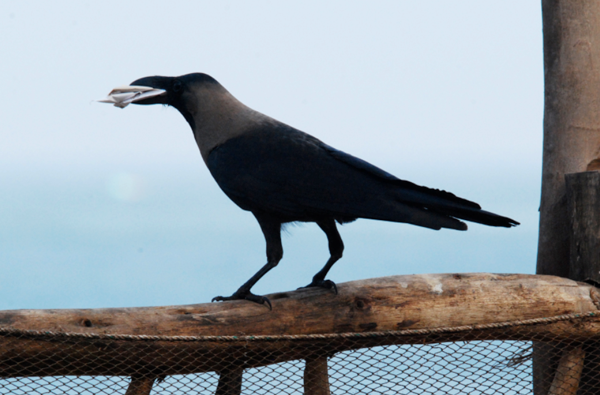
The crow offered me the first bite, generously. Politely I had to refuse. Our friendship was by now so congenial that I choose not to bring up the issue of my vegetarianism. I feared that something so trivial might soon snowball into an insurmountable mountain of mutual dislike. Like it happens often in human friendships. But I should have known better. For it was a crow that I had befriended. Giving me a deep, keen look the bird nodded his head and got back to his snack.

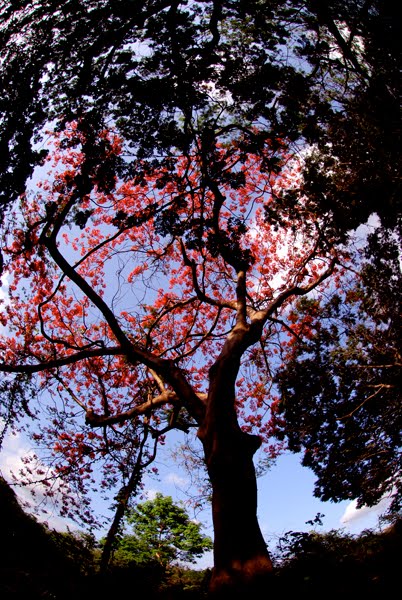
Did he know why I refused his friendly offering? I don’t quite know the answer to that. It never came up. However, there have been no wormy offerings of friendships ever since but many a cheery caw and circling over the head. And even a few striking poses among the blooming gulmohar. Yeah, we are alright. At least for now.

In fact, Mark Twain was onto something when he wrote that the crow “never arrived at what he is by any careless process, or any sudden one; he is a work of art, and "art is long"; he is the product of immemorial ages, and deep calculation; one can't make a bird like that in a day.”

(You can read Mark Twain's brilliant essay on the Crow here)

Friday, 21 May 2010

Was there a time


Was there a time when dancers with their fiddles
In children's circuses could stay their troubles?
There was a time they could cry over books,
But time has set its maggot on their track.
Under the arc of the sky they are unsafe.
What's never known is safest in this life.
Under the skysigns they who have no arms
Have cleanest hands, and, as the heartless ghost
Alone's unhurt, so the blind man sees best.

(Was There A Time by Dylan Thomas)

Wednesday, 19 May 2010

Does your conscience bother you

The glory of friendship is not the outstretched hand,

nor the kindly smile nor the joy of companionship;

it is the spiritual inspiration that comes to one when

he discovers that someone else believes in him and is

willing to trust him.

Glory of Friendship by Ralph Waldo Emerson


or, in other words


If a dog will not come to you after having looked in your face, you should go home and examine your conscience.

- Woodrow Wilson

Wednesday, 5 May 2010

Postcards from Italy

waiting to be addressed...


The times we had
Oh, when the wind would blow with rain and snow
Were not all bad
We put our feet just where they had, had to go
Never to go...


Those were our times, those were our times

Saturday, 1 May 2010

The bar. Code.

“Debates, I tell you,” you start. It’s one of those days. Only instead of late nights, it’s in the middle of the day that we’ve gather around to listen. And what better way to pass the time. I say it sans all sarcasm. Or maybe not.

The AC works hard to keep the room at a ‘pleasant’ 20 degree Celsius. The first person to mention climate change or carbon footprint is quickly banished to the common lot outside. A few minutes in the ‘real’ world, with the added heat reflected from the million odd cars parked there, and anyone can be tempted to join cause with the ‘skeptics’. Or at least silently thank human creativity for inventing air conditioning and hope that somewhere it’s working over time to discover clean sources of endless energy. However, getting back to your monologue.

"Why don’t our internet identities carry a bar code like thing?" you continue, "I am sure they can come up with some system whereby whenever we comment, or appear on any social media network, we carry our ‘aura’ with our avatars. The aura will naturally be colored by the education we’ve had, the job we do. In short our credentials.

So if in the course of a discussion we disagree or agree with something, the other participants by simply looking at the colour of our aura can choose to understand or misunderstand us. They can then swiftly typecast us and respond accordingly.

Imagine the time saved by not having to ask the same questions, again and again - what are your credentials for saying so? Are you a scientist, an activist, or whatever ‘ist’ the discussion requires? What’s your education qualification? It’s as if all those who haven’t been to Harvard, Wharton or IIT and IIM. Or for that matter not slogged for PhD’s and doctorates. Or haven't lived, danced and supped with the remote indigenous communities of the world. Or not seen a whale or a chimpanzee for real. All these people can’t express their opinions.

So, your grandmother may have lived in a world without plastic bags, water shortage or the need for food to have labels that display the chemicals in them but sorry what makes her think she can bring something to the discussion? What are her credentials? Ajay, the 15 year old, who comes to clean the million cars parked in the lot may have migrated from the invisible interiors of India but do you really think he can add anything to the debate? Can he even spell development?

On the other hand the NGO that person is working with; it’s bringing ‘civilization’ to indigenous communities. So (hello!) naturally this person’s opinion counts. As does of the person who has read every word ever written about the problem and can Google up links faster than you can open a new tab. Or the person who has been on every committee ever formed in the last 62 years to deal with the problem. Umm, yes the problem still persists but at the moment we are only talking about whose opinions matter. And clearly the odds are stacked in favor of people who can display the right credentials. It’s all about credentials, credentials, credentials. However, only very selective kinds are appreciated."

At this point you pause to sip gently at the lemonade sitting next to your monitor. I see you are logged onto Facebook. I almost smile as I wonder how many more such rants lie ahead.

Suddenly the AC shudders to a halt. Another power cut. General mutterings and some odd abuses fill the room. The windows of this ‘modern ultra-tech’ building don’t even open. We look outside at the slums and the peepul tree with its pink leaves gently fluttering.

We blankly stare at the wide world that lies beyond. We can’t interact with it.

Wednesday, 28 April 2010

I went to Goa

and this is what I did see;
Goa of the sea

for whatever we lose (like a you or a me)
it's always ourselves we find in the sea
-e.e. cummings

Goa of the beaches

In every outthrust headland, in every curving beach, in every grain of sand there is the story of the earth.
-Rachel Carson.

And more beaches

where everyone has to be!

Goa of the sunsets

A beautiful sunset that was mistaken for a dawn.
-Claude Debuss

Goa of the Churches

and their equally ancient companions, the beautiful rain trees.

Goa of the old houses

waiting to be torn down and rebuilt as grotesque multi-coloured, perhaps 'neo-Mediterranean' styled, high rise apartments.

Goa of the rivers and the green hills beyond

and a constant to and fro of barges carrying iron ore.

Goa of the Banyan tree

To study a banyan tree, you not only must know its main stem in its own soil, but you must trace the growth of its greatness in the further soil. Only then can you know the true nature of its vitality.
-Rabindranath Tagore
Interestingly, Tagore was comparing Indian civilization to the banyan tree. With every square foot of land being mined for money, I wonder how many banyan trees are being planted now. And what does that say about the 'vitality' of our civilization.

Goa of the birds

There is nothing in which the birds differ more from man than the way in which they can build and yet leave a landscape as it was before.
-Robert Lynd

Monday, 26 April 2010

It can't be "Summer"!


It can't be "Summer"!
That - got through!
It's early - yet - for "Spring"!
There's that long town of White - to cross -
Before the Blackbirds sing!
It can't be "Dying"!
It's too Rouge -
The Dead shall go in White -
So Sunset shuts my question down
With Cuffs of Chrysolite!

by Emily Dickinson

Thursday, 22 April 2010

Sparrow Day Care

Our tiny balcony, if we can classify the space just beyond the ‘French windows’ as that, has been taken over by the Sparrow Day Care Centre. As soon as we wake up and draw the curtain there they are, mother sparrows and baby sparrows, lined up waiting for their meal of rice and bajra. After much chattering, shaking of wings and running around the little ones are fed to satisfaction. The mothers then go on to do what mothers have to do, while the little ones stay in the ‘Day Care Centre’ doing what little ones do best.

Eating

Wondering

Preening

Sleeping

Exploring

Demanding

And eating some more

But at the first caw of the crow, or the first beep of the car horn, the mothers are back and the chattering, shaking of wings and general running around commences again. Till it’s finally time for bed.

Thursday, 15 April 2010

The cows are worried


Now the cows were worried. They had had wide ranging discussions with the hens, the banyan tree, her, the toads, the slugs; well everyone. They had trekked all the way to talk to the polar bears, the giant sequoias, the blue whale, even tracked down the last of the tigers, the elusive yeti; in short they had been really thorough and very professional. But now they were simply worried. And they needed to think hard.

For, you see in this world, to offer an opinion about anything, even something that impacts you personally or you are responsible for, you have to take position under narrow, iron-clad categories created by men. And then it is decided whether you are with ‘us’ or with ‘them’.

No one quite understands whom this ‘them’ and ‘us’ refers to, but then the cows in the many discussions mentioned above realized that humans aren’t very rational after all. And the issue why only such irrational beings get to decide what is good for the Earth did also come up, but then that was another matter. Right now what the cows were worried about was these iron clad categories.

What they had to say was very important. But who’d pay attention if they didn’t file it under some category. However, they also understood that the moment they did so, the ‘us’ and the ‘them’, whoever they might be, would get into a fight and what they had to say would die even before it saw the light of day.

Ordinarily, fitting things into neat categories was something they’d associate with simple minds, unable to comprehend the complexities of life. But it was rumored that humans had the biggest brain, at least that’s how humans claimed they knew what was best for the earth. It was all getting too fretful and worrisome. And at any moment the sun too would set.

All of a sudden the cows had an ‘eureka’ moment. They looked at each other and offered a celebratory moo. And recollected the famous words, ‘We can't solve problems by using the same kind of thinking we used when we created them.’

Rejecting all the old categories, they created a new category. And now they wait for the discussions to begin.

Monday, 12 April 2010

Caterpillars

I am appalled by your apathy. When Professor Das delivered this statement, we were sitting in the verdant lawns of Delhi University on a pleasant October morning. That itself will give you a fair idea about how long ago it was. For can they sit outside in verdant green lawns (are there any left?) in Delhi anymore? Is October pleasant? However in this case the setting was perfect and to give Professor Das due credit thoughtful too. Even at 9:00 AM not many possess the moral fiber to be pert and snappy especially when discussing ‘The Elements of Semiology’. Barthes at any time of the day requires a certain kind of aptitude. In us it was clearly lacking, regardless of the hour, even with the added knowledge that this will “come in the exams”. The setting though kept us alert, and occupied otherwise.
 
The cause for the comment was the fact that being diligent scholars we had carefully read to the last page, even the last alphabet exactly the portion that had been prescribed for the current tutorial, the introduction and first few chapters, not a page more, though in hindsight probably a few pages less. So when in the discussion the good Professor started talking about the ‘non-prescribed’ portion, the blank expression on our face was a pretty accurate sign of how clueless we were. And so the Professor with her crisp accent, and that certain tone because of which quite frankly everyone was a bit terrified of her, delivered the fateful line.
Unlike her, Professor Baviskar probably had very accurate information regarding our mindset. She always ended the announcement of the reading list with the words, “And don’t just read the underlined sentences. Make an effort to at least read complete paragraphs.” But then she too not so long ago had attended similar tutorials, even borrowed the same books from the library, and knowing that certain streak in her, probably with a twinkle in the eye even underlined the least important passages.
However it’s the words of Professor Das that became immortal. In the days since that tutorial I have whispered them many a times, in many different circumstances. I don’t know about the other four in the tutorial group but for me they have become a connotation. My limited reading of Barthes is probably flawed but these words and the circumstances they were uttered in have come to signify something much greater than a tutorial discussion many moons ago. That belief that it’s necessary to only know enough to “pass the exam” or get a promotion or achieve a certain level of success in life. That inability, widespread and on constant display, to read. That lack of curiosity to look beyond that, which concerns us. Aren’t these all manifestations of reading only prescribed portions, without making an effort to even glance at the next page? Epitomizing the appallingly apathetic culture of clearing exams without any concern for acquiring knowledge. Chasing lifestyles without any empathy for life. Of living in cocoons blind to everything else beyond. 
Postscript: Caterpillars aren’t blind. They have six pairs of simple eyes (ocelli) that can detect changes in light intensity, but cannot form an image.
After writing this post through a strange combination of Google searches (lets just say it’s something I do) I suddenly came upon this: “The caterpillars in distress, starved, shelter-less, chilled with cold at night, cling obstinately to the silk ribbon covered hundreds of times, because they lack the rudimentary glimmers of reason which would advise them to abandon it.” (The Life of the Caterpillar by J. Henri Fabre, 1916)

Wednesday, 7 April 2010

The other Paris


And so we begin our search. We are looking for the ‘other Paris’. Not the kind that Carol yearned for in the story called ‘The Other Paris’ by Mavis Gallant. Quite on the contrary we begin looking for Paris that is far removed from all its association with romance and literature and art. In fact, the Paris that exists after every layer of imagery bestowed by imagination, artistic or otherwise, is exfoliated.
For what does one do when one has swooned over Paris from atop the Eiffel tower, and Paris on a clear day as seen from Montmarte, and Paris as seen from a boat ride in the Seine, and Paris at night, and Paris that exists in the museums and the boutiques, and Paris of the cafes and churches, and Paris of the movies, and Paris that is every tourist’s fondest dream. Then one simply goes looking for the other Paris.
Sometimes one finds it in the patisserie next to Gare de l’Est, where it gets communicated through a mixture of mispronounced French words, scattered English and imaginative hand gestures. Or sitting in the corner bench opposite the tree laden with mysterious orange fruit, as the sparrows come and peck at our shoes while old men throw them crumbs. Or during breakfast in the rooftop garden among blooming lavender where the honey jars have to be shut tightly lest they attract bees. Or in the eyes of the woman who sings as the train rushes past decaying tenements into the heart of Paris. And in the dragging feet of the little boy whose mother pulls him away even as his eyes are transfixed by the photographs from Antarctica exhibited on the outer walls of Jardin du Luxembourgh. And most poetically expressed by the man who sits with his back to the Eiffel tower as the lights come on.